
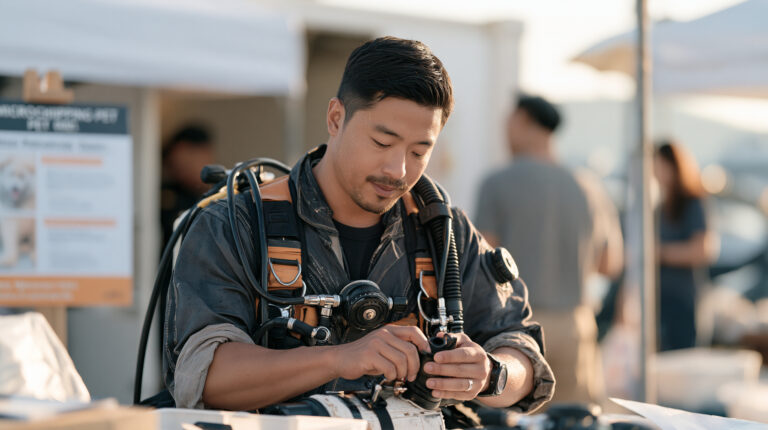
Over the past twenty years, rebreathers have moved from military and technical diving to becoming commonplace in recreational diving. The term should simply be “closed-circuit rebreathers” (CCRs) or “semi-closed rebreathers.” There is no such thing as an open-circuit rebreather. In the last ten years, especially, these devices have gained popularity among photographers, advanced recreational divers, and liveaboard operators who value their advantages.
What is a rebreather?
Unlike traditional scuba gear with open-circuit regulators, this diving technology recycles gas, extending underwater time. Gas recycling happens by removing carbon dioxide and adding oxygen, so most breaths are reused rather than vented as bubbles, unlike open-circuit setups with standard regulators. For newer and recreational divers considering future pathways, the headline advantages are longer underwater time, quieter encounters with marine life, more comfortable breathing, and potentially more efficient decompression planning—with the critical caveat that rebreathers require dedicated training and disciplined procedures.
Core benefits compared to standard regulators
Extended bottom time
Because oxygen is added to match metabolic use and gas is recycled, rebreathers deliver dramatically greater gas endurance—especially at depth where open‑circuit consumption rises with pressure.
Fewer or quieter bubbles
CCRs operate nearly bubble‑free during typical phases, reducing noise and disturbance, enabling closer, calmer wildlife encounters, and reducing silt disruption in confined spaces.
Warmer, humid breathing gas:
Loop gas retains heat and moisture, which improves comfort on extended dives and reduces dehydration and chill versus the dry, cool gas from open‑circuit regulators.
Potential decompression efficiency
Holding a higher, constant PO2 within safe limits can limit inert gas loading and may shorten decompression relative to fixed‑mix open circuit when used correctly.
Streamlined gas logistics
Recycling gas reduces the need to carry large volumes, and optimizing mixes can lower helium use and costs for advanced dives, aiding expedition range and planning.
Real‑world impact for beginners
At typical reef depths, the most noticeable advantage is simply spending more time underwater, which means extra minutes to compose photographs, watch behavior, and soak in the scene before ascent planning becomes necessary, thanks to the system’s gas‑recycling efficiency compared with open circuit. The experience also feels calmer around marine life because rebreathers operate with minimal bubbles and hiss, so fish and mammals are less likely to be startled—an effect underwater photographers and naturalists often leverage to get closer without disturbance. On longer dives, breathing through the loop is more comfortable as the gas is warm and humid rather than the cold, dry flow of typical open‑circuit regulators.
Balanced view: responsibilities and training
Rebreather training is essential for anyone transitioning from recreational scuba diving to advanced diving systems. The mandatory first step into CCR diving is a Level 1 (often called “MOD 1”) course, which introduces divers to unit setup, oxygen control, bailout planning, and emergency drills. Most agencies (TDI, IANTD, RAID, PADI TecRec) require divers to be already certified to the Advanced Open Water level with at least 30–50 logged dives before enrolling. The MOD 1 takes about 5–7 days, with a mix of confined-water and 6–8 open-water training dives. Prices vary by region and agency, but divers should expect to invest around US $1,500–3,000 for training alone, not including unit purchase or rental. This structured entry ensures divers gain the habits, awareness, and discipline essential for safe rebreather use.
Training is essential because, unlike on an open-circuit system, mistakes on a rebreather may not give obvious warning signs until it is too late. Proper instruction builds the discipline of checklists, sensor validation, and bailout readiness, which are the diver’s lifelines in preventing hypoxia, hyperoxia, or CO₂ buildup.
Bottom line for new divers
Open‑circuit regulators remain the simplest, most affordable way to build foundational skills and confidence, and they’re the right starting point for most beginners. But for divers passionate about scuba gear, encounters with marine life, or learning new diving technology, rebreather training may be the perfect next step. The benefits of rebreathers can open a rewarding path into longer, more immersive underwater time.
It’s worth noting that helium, often mentioned in discussions about rebreathers, only comes into play at the second level of CCR training and beyond, when divers go deeper into technical territory. Recreational CCR divers at reef depths use only air or nitrox and never touch helium. Where helium matters is for advanced dives, because rebreathers recycle expensive trimix blends, making such explorations more practical than open-circuit.
Whether your goal is to enjoy more relaxed reef dives, capture closer encounters with marine life, or one day explore the technical side of diving, rebreathers are becoming more accessible than ever. Ask your local dive center or instructor about a rebreather experience program or an entry-level course—it could be the next step toward longer, quieter, and more immersive underwater adventures. If your SCUBA journey passes through North Carolina, contact By The Shore SCUBA Instruction for diving courses, equipment, and more! Kevin Alexander, our experienced PADI instructor, provides open water dive courses, equipment expertise, and occasionally sets up dive charters. Call us for our current events and more!
Sources-
Rebreathers—Are They for Me? –