
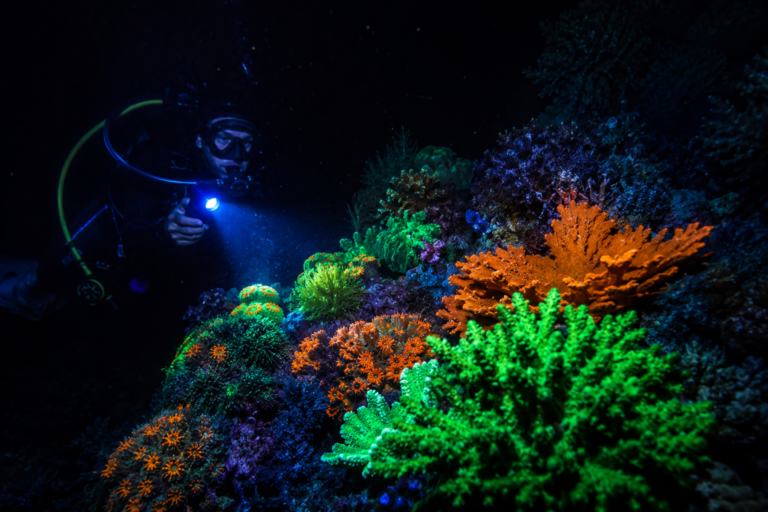
A World Like No Other
Imagine descending onto a reef at night and seeing something completely different from what you saw during the day. The reef is dark, your regular dive light is switched off, and suddenly corals, anemones, and other marine life begin glowing in bright greens, oranges, reds, and yellows. That is the magic of fluorescence night diving. Fluorescence night diving is a type of night dive where you use a special blue light to see corals and other marine life glow in bright colors.
Fluorescence Night Diving For Beginners
Fluorescence night diving, sometimes called fluo diving, is a type of night dive where divers use a special blue light to illuminate marine life. Instead of reflecting the blue light like an object normally would, certain organisms absorb some of that light and release it again as a different color. This is called fluorescence. It is also important not to confuse fluorescence with bioluminescence.
Bioluminescence Versus Fluorescence
Bioluminescent animals produce their own light through a chemical process, while fluorescence happens when an organism absorbs light from an external source and re-emits it at another wavelength. The result can be surprisingly bright. A coral that looks ordinary under daylight may suddenly appear neon green or orange when you shine the right blue light on it. And here is the fun part: you often cannot tell just by looking at a creature during the day whether it will fluoresce at night.
Why Does the Reef Glow?
The science sounds complicated at first, but the basic idea is pretty simple. Some marine organisms contain fluorescent proteins or pigments. When blue light reaches these compounds, they absorb energy from the light and then release some of that energy as light of a different color. That is why the blue light can reveal colors such as green, yellow, orange, and red. The exact color and brightness depend on the organism and the fluorescent compounds it contains. Corals are some of the most impressive subjects, but they are not the only things worth looking for. Depending on the dive site, you may discover fluorescent anemones, fish, small marine creatures, and other reef life.
What Do You Need for a Fluorescence Dive?
The good news is that you do not need an enormous amount of new equipment to experience a fluorescence dive. You still need your normal scuba diving equipment, but you will also use a blue excitation light and a yellow barrier filter for your mask. The yellow filter blocks much of the reflected blue light and makes the fluorescent colors easier to see. Think of the blue light as the thing that reveals the hidden colors, while the yellow filter helps your eyes see those colors more clearly.
Fluorescence Photography
A normal white dive light can also be useful for navigation and safety. During the actual fluorescence viewing, however, too much white light can overpower the effect you are trying to see. If you are taking a camera, you will usually need the appropriate filters for your camera setup as well. Fluorescence photography has its own learning curve, so for your first dive, I would honestly recommend spending more time looking around than worrying about getting the perfect photo.
Is Fluorescence Diving Suitable for Beginners?
This is where it is worth slowing down for a moment. Fluorescence diving is exciting, but it is still a night dive. Once the bright white light is removed and you are relying mainly on a blue light and the fluorescent glow, your surroundings can become much darker than you might expect. Good buoyancy control is especially important because it is easier to lose sight of the reef, and you do not want to accidentally touch or damage delicate marine life.
Divers Alert Network
Divers Alert Network also recommends keeping a backup white light available so you can properly see your surroundings when necessary. For someone who has never done a night dive before, it is a good idea to become comfortable with normal night diving first. Some training providers also offer dedicated fluorescence or night diving courses that introduce the equipment, procedures, and safety considerations under professional supervision. Your instructor or dive school can help you decide when you are ready.
What Equipment Do You Need?
You do not need a huge amount of extra equipment for a fluorescence dive. Along with your normal scuba gear, you will usually need:
- Blue dive light: Helps reveal the fluorescent colors.
- Yellow mask filter: Makes the glowing colors easier to see.
- Yellow camera filter: Helpful if you want to take photos.
- Backup white light: Important for safety and navigation.
The blue light reveals the hidden colors, while the yellow filter helps your eyes see them more clearly. If you are taking a camera, you may also need a suitable filter for your setup. But for your first dive, do not worry too much about getting the perfect photo. Take some time to simply enjoy what you are seeing.
What Can You Expect on Your First Fluorescence Night Dive?
The first few minutes may feel a little strange. You enter the water, descend, and begin looking around. Under normal conditions, you might be used to following the beam of your dive light. With fluorescence diving, the environment feels much darker. Then you point your blue light toward the reef. Suddenly, something catches your attention. Maybe it is a small patch of coral glowing bright green. Maybe an anemone appears orange or red. You move your light a little farther and discover another glowing patch nearby. This is what makes fluorescence diving so addictive. You start looking for tiny details that you probably would have ignored during a normal dive. A familiar dive site can suddenly feel completely new.
A Few Tips Before You Try It
If you are planning your first fluorescence night dive, keep things simple. First, make sure you are comfortable with your buoyancy and basic night diving skills. You want to be able to control yourself in the water without constantly worrying about where your fins or equipment are. Second, stay close to your buddy and follow the dive plan. Night diving changes your visibility and sense of direction, so communication and awareness become even more important. Third, carry a backup white light and know how to use it. The fluorescent glow is beautiful, but it is not designed to illuminate the entire reef around you. Finally, take your time. You do not need to swim quickly from one part of the reef to another. Some of the best discoveries can be very small. Slow down, look carefully, and let your eyes adjust.
Ready to See Diving in a New Light?
One of the best things about scuba diving is that there is always something else to discover. You can explore wrecks, reefs, caves, walls, and deep sites, but sometimes you do not even need a completely new dive location to have a new experience. Fluorescence night diving can take a reef you already know and show it to you in a completely different way.
Ways to Book A Tour
If you have been curious about night diving and want to try something unusual, this could be the next adventure worth adding to your dive list. And who knows? You might switch off your regular light, turn on that blue beam, and discover that the reef has been hiding a neon world from you all along. Locations with high fluorescence diving charters starting at $90 per person include Culebra in Puerto Rico, Grand Cayman, Aruba, and Thailand. Planning in advance to attend these dives would be a way to commit to a dream come true. To view different diving courses and group charters check out By the Shore SCUBA Instruction.
Sources
National Geographic: Fluorescent Night Diving
Divers Alert Network: Seeing the Reef in a New Light