
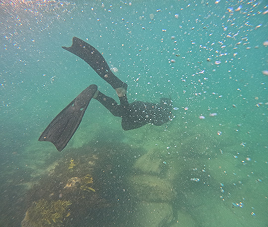
How Low Can You Go?
Exploring the fascinating underwater world is a goal for many SCUBA divers who want to experience underwater beauty, see marine animal species, explore shipwrecks, and enjoy ocean landscapes. However, one of the most common questions among both novice and experienced divers is: how deep can a person SCUBA dive?
The Ultimate Limit: How Deep Can You SCUBA Dive Underwater?
Depending on various factors such as certifications, equipment, gas types, diving conditions, and skill level, a SCUBA diver can go deeper underwater than expected. Most often, regular recreational divers stick to relatively shallow waters. Meanwhile, those with special training can reach astonishing depths. However, diving deeper comes with a price: serious risks.
How Deep Can a Recreational SCUBA Diver Go Normally?
Recreational diving has a theoretical and recommended maximum depth that no diver should ever approach. In general, 40 meters is the standard recreational diving depth, whereas divers with some special training or certifications can go deeper. Also, consider bottom time; the longer you stay underwater, the more gas you will consume. Therefore, it is crucial to plan and track depth and time spent during the dive and calculate gas.
Water Pressure Explained
Every diver knows that the deeper they go, the higher the pressure will be. But have you ever asked yourself why exactly it happens? Well, the main reason is that for every 10 meters of depth, an additional atmosphere of pressure is added. So, at the surface, the atmospheric pressure is already 1 ATA (atmosphere absolute). Furthermore, at 10 meters, the diver will experience an absolute pressure of 2 ATA; at 20 meters, 3 ATA; at 30 meters, 4 ATA, and so on. The increased pressure directly impacts the gas that the diver is breathing underwater. The deeper the diver goes, the more gas volume they have to deal with per minute. Consequently, the air consumption increases significantly, especially at depths beyond 30 meters. Moreover, gas pressure also affects the gas spaces within the human body. A diver must equalize the pressure in the air spaces to avoid serious injuries during the descent.
What Causes Nitrogen Narcosis?
One of the most notable side effects of diving deeper is nitrogen narcosis. The main characteristic of this condition is that it severely impairs a person’s judgment and coordination. At depths beyond 30 meters, gas molecules such as nitrogen can deeply penetrate the central nervous system, intoxicating it. As a result, a diver may feel excessively happy, lose coordination, start behaving foolishly, or even forget about basic diving safety rules. Nitrogen narcosis only occurs when a diver uses compressed breathing gas, which is standard for open-circuit SCUBA diving. The good news is that there is usually a simple remedy for nitrogen narcosis – ascending to a shallower depth. It should be noted that the diver’s condition will drastically improve as soon as the partial pressure of nitrogen decreases.
Going Deeper: The Technical Diving Side
When it comes to technical diving, the situation changes fundamentally. Technical divers go much deeper than regular SCUBA divers, equipping themselves with special gear, multiple gas cylinders, dive computers, and other technical diver tools. There are also different gas options for technical diving, including nitrox, trimix, and heliox, among others. Each of these gas mixtures has its own characteristics and purposes. For example, heliox is a breathing gas consisting of helium and oxygen with no nitrogen at all. Since nitrogen is the major cause of narcosis, a heliox mixture helps avoid this condition at extreme depths.
How Deep Has a Human Being SCUBA Dived?
Deep diving is not only a hobby or sport for some people – it is their occupation. Specialized divers who engage in such an activity have broken numerous world records, including the deepest SCUBA dive. The record belongs to Ahmed Gabr, who dove to a depth of 332.35 meters in the Red Sea, Egypt, in 2014. Such a dive requires exceptional training and equipment, as well as a substantial amount of time to ascend back to the surface safely. A diver who has descended to such depths may experience serious health complications due to extreme nitrogen narcosis.
What Does an Extreme SCUBA Diving Experience Entail?
When diving deeper, several serious concerns should be taken into account. First, the diver will consume gas at an extremely high rate. Second, the diver will need a considerable amount of time to decompress and return to the surface safely. Finally, a diver who goes beyond 100 meters will likely experience intense nitrogen narcosis. Additionally, diving deeper increases the risks of decompression sickness (“the bends”) greatly. Divers’ bodies absorb inert gases at great depths, and if a diver ascends too quickly, gas bubbles may form in the tissues, damaging them. This unfortunate situation can easily be avoided if the diver makes proper decompression stops during the ascent.
Is Deeper Better?
When it comes to diving, deeper is definitely not better. There are some truly spectacular underwater sights at depths up to 40 meters. At these depths, the light that comes from the water surface filters through the water, creating unique effects and making the underwater flora and fauna extraordinary. For recreational divers, it is essential to stick to the recommended maximum depth of 40 meters and always follow standard diving safety rules.
The Real Limit of SCUBA Diving
So, how deep can one SCUBA dive? Depending on the diver’s training, equipment, gas mixture, environment, and other factors, the depth varies. A diver with special training may go several hundred feet below the surface. A recreational diver, on the other hand, is generally limited to depths up to 40 meters. However, there are more factors to consider than just training and gas mixture. A diver must possess the appropriate equipment, such as a sturdy dive computer, primary and alternate SCUBA tanks, a reliable regulator, and a buoyancy control device (BC). Furthermore, the diver must know the entry and exit procedures, as well as diving safety rules and first aid rules. One should also understand the effects of the surrounding environment, current, and gas consumption on the dive. If you want to tap into your full potential as a SCUBA diver, sign up at By the Shore SCUBA Instruction for courses and SCUBA excursions! Ask Kevin Alexander, our PADI Master, for information on upcoming boat or excursion charters!
Sources-
-https://www.instagram.com/p/DXhKpaxFe6Y/
-https://www.factcheck.org/scicheck/
-https://exploration.xdeep.eu/projects/ahmed-gabr-deepest-dive-red-sea-egypt
-https://www.youtube.com/watch?v=Oe3OlP6Z8-s
-https://oceanexplorer.noaa.gov/technology/technical/
-https://www.naui.org/understanding-recreational-limits/
-https://en.wikipedia.org/wiki/Deep_diving
-https://www.scubadiving.com/why-is-130-feet-depth-limit-for-recreational-scuba-diving
-http://ahmedgabr.com/Pages/InnerPage.aspx?PageId=16
-https://www.guinnessworldrecords.com/world-records/deepest-scuba-dive-(male
-https://www.youtube.com/watch?v=pOZsMSKxbpg
-https://swimandscuba.com/how-deep-can-a-recreational-diver-go/
-https://www.reddit.com/r/scubadiving/comments/trxcex/so_they_said_average_depth_is_130ft_for_scuba/
-https://www.divessi.com/en/blog/how-deep-can-scuba-divers-go-2775